
Scenario Analysis
How do we stress test your transition plan with scenarios?
Methodology foundations
Our scenario analysis aligns with the Recommendations of the Task Force on Climate-related Financial Disclosures (TCFD).
TCFD recommends that companies use climate-related scenario analysis to test the resilience of their strategy against different temperature pathways (e.g., 1.5°C and a worst case scenarios) and then align their GHG decarbonisation plans accordingly.
What this means for your decarbonisation plan, is that you should model how your transition plan (i.e. + internal actions pathway) would evolve under various transition scenarios, and identify the internal actions required to remain consistent with your target pathway.
This stress-testing of your transition plan gives investors greater confidence that your business is prepared for the future. They want to see time-bound targets, capital allocation alignment, operational measures, and governance oversight, to ensure your plan is credible under multiple °C-aligned futures.
Recommended by TCFD
The scenario analysis takes your transition plan ('+internal actions pathway') and stress tests it under multiple differing narratives for how quickly (or slowly) society as a whole decarbonises.
Coherent narratives are crafted to describe a world headed for x°C warming, based on assigning specific forecasts of external trends projections together into the narratives aligned to the Shard Socio-economic Pathways (SSPs).
For example, the IEA have determined a normative pathway that the emission factor for electricity should follow, in order for society to reach +1.5°C. On the other hand, they have also described how a slower decarbonisation of electricity would lead to a +3 °C world.
How does it work behind the scenes?
click to expand
click to expand
Conclusion
Scenario analysis is not a forecast but a decision-support tool.
It helps you test whether your current transition plan holds up under different plausible futures.
By observing how your emissions pathway shifts across these narratives, you can identify no-regret actions, stress-test assumptions, and prioritise interventions that deliver resilience and flexibility.
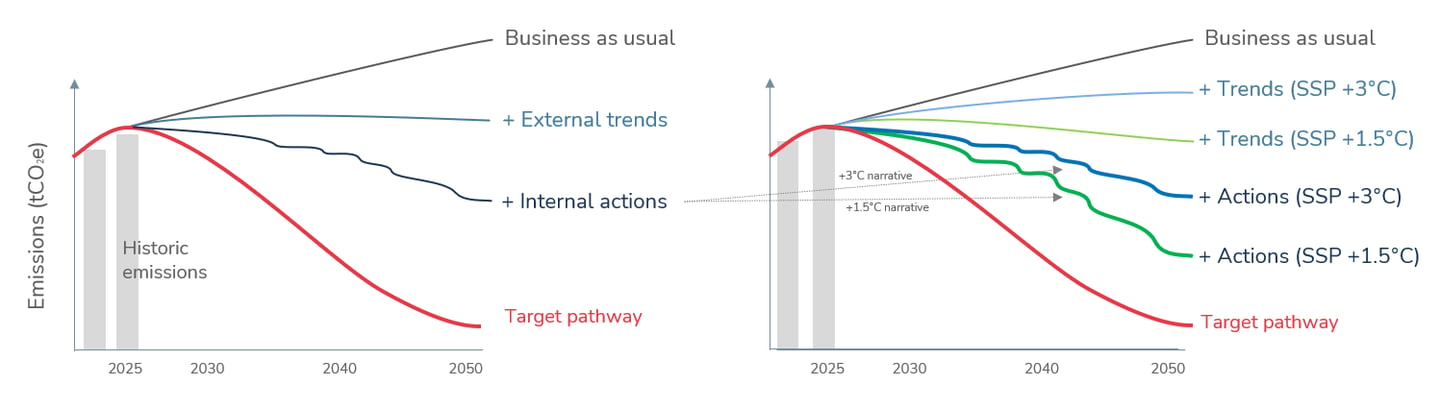
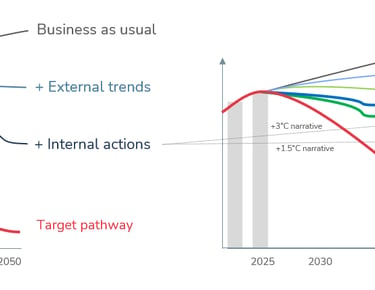
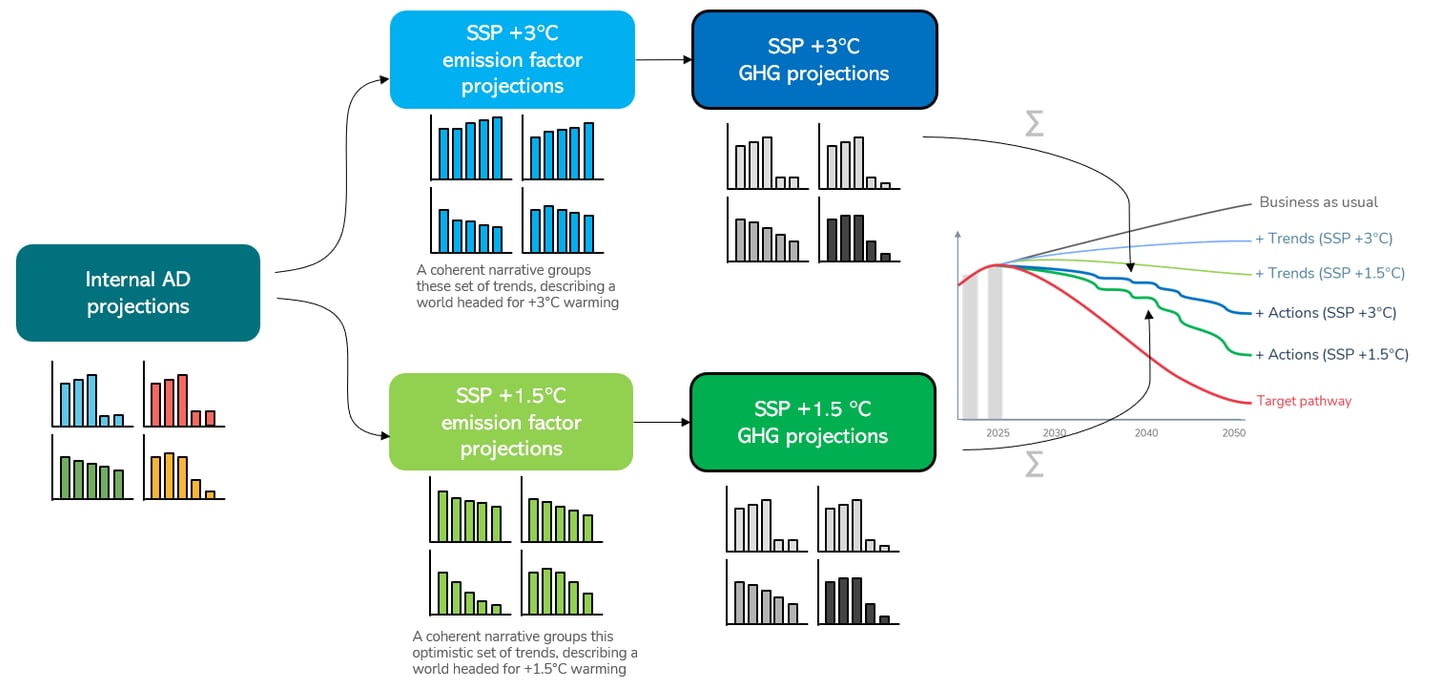
The arrays of activity data in your '+internal actions pathway' is passed through multiple iterations of the projection engine, with each iteration subjected to differing assumptions about the rate of change of external trends. Each SSP narrative contains a coherent set of forecasts for the speed at which society and other industries will decarbonise.